

Aug. 22, 2018
Research Highlight
Draft Genome Sequences from a Sulfidic Hot Spring
Researchers have described the first genome sequences of Anaerolineae acquired from a hot spring environment. Anaerolineae is a class of the phylum Chloroflexi, and has been identified in 16S sequence data from many environments. However, previous sequence data for Anaerolineae has only been obtained from ground and waste water systems. The newly acquired sequences were obtained from a sulfidic hot spring in Japan.
The two genome sequences are thought to be from lineages that branched soon after the divergence of a sister class known as Candidatus Thermofonsia. The study could thereby help to expand knowledge of the metabolic evolution of this group of organisms.
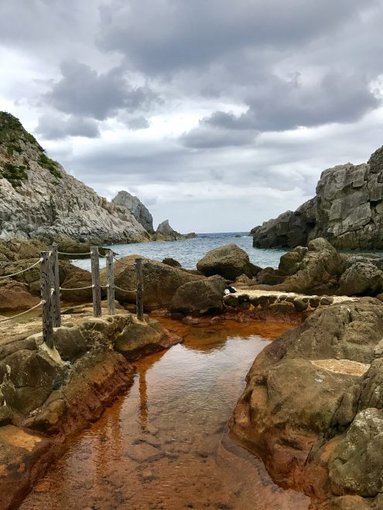
Scalding hot water from an underground thermal spring in Japan creates an iron-rich environment.Image credit: Nerissa Escanlar.
In a second paper, the research team also reports the first draft genome sequence of the Chloroflexi class Ardenticatenia obtained from a hot spring environment (which is also only the second sequence overall). This sequence, dubbed Nak82, is likely newly identified genus- or family-level lineage.
The first paper, “Draft Genome Sequences of Two Basal Members of the Anaerolineae Class of Chloroflexi from a Sulfidic Hot Spring,” was published in the journal Microbiology: Resource Announcements. The second paper, “Draft Genome Sequence of a Divergent Anaerobic Member of the Chloroflexi Class Ardenticatenia from a Sulfidic Hot Spring,” was also published in the journal Microbiology: Resource Announcements. The work was supported in part by NASA Astrobiology through the Exobiology Program, the Lewis and Clark Fund for Exploration and Field Research in Astrobiology, and the Earth-Life Science Institute (ELSI) Origins Network.