

Aug. 20, 2018
Research Highlight
Volcanism and Crustal Formation on Planetesimals in the Early Solar System
Study of the achondrite meteorite NWA 11119
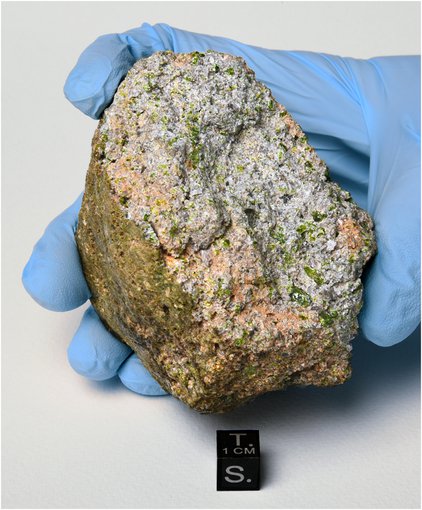
Photograph of the main mass of NWA 11119 that was found in Mauritania in December 2016. The rock has a light-green fusion crust, and the broken interior shows light-green and gray-colored crystals.Image credit: © 2017 B. Barrett/Maine Mineral & Gem Museum; Srinivasan et al. (2018).
A unique volcanic meteorite found in Northwest Africa is providing new details about volcanic rock compositions from the first 2.5-3.5 million years of the Solar System. The meteorite, NWA 11119, was reportedly discovered in 2016 in Mauritania and is an example of an ancient achondrite meteorite. Studying ancient rocks like NWA 11119 can reveal important clues about how planetary building blocks evolved in the early Solar System because they are a record of the first known examples of volcanic and crust formation events. The study on NWA 11119 reveals evidence that chemically evolved crustal rocks formed on planetesimals in the early Solar System, before the planets themselves even formed.
The paper, “Silica-rich volcanism in the early solar system dated at 4.565 Ga,” was published in the journal Nature Communications. This work was supported by the Emerging Worlds Program. The NASA Astrobiology Program provides resources for Emerging Worlds and other Research and Analysis programs within the NASA Science Mission Directorate (SMD) that solicit proposals relevant to astrobiology research.