

July 2, 2018
Research Highlight
Theories on the Origin of an Interstellar Small Body
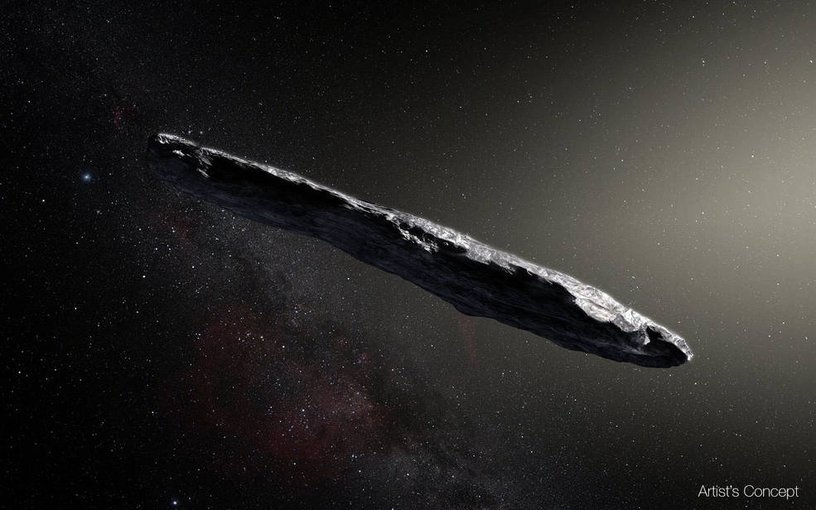
Artist’s concept of interstellar asteroid 1I/2017 U1 (‘Oumuamua) as it passed through the solar system after its discovery in October 2017. The aspect ratio of up to 10:1 is unlike that of any object seen in our own solar system.Image credit: European Southern Observatory/M. Kornmesser.
A recent paper explores the potential origins of 1I/‘Oumuamua and the types of systems from which the object may have been ejected. ‘Oumuamua is the first known interstellar small body and was discovered by the Pan_STARRS survey. It has an elongated figure and does not exhibit any activity. ‘Oumuamua is very different in its appearance to small asteroids, and the study concludes that this may be because the object is not a member of a collisional population.
The study, “1I/‘Oumuamua as a Tidal Disruption Fragment from a Binary Star System,” was published in the journal The Astrophysical Journal Letters. This work was supported by the Emerging Worlds Program. The NASA Astrobiology Program provides resources for Emerging Worlds and other Research and Analysis programs within the NASA Science Mission Directorate (SMD) that solicit proposals relevant to astrobiology research.