

Jan. 16, 2024
Research Highlight
The Salty Limit of Life
Microbial activity in hypersaline waters.
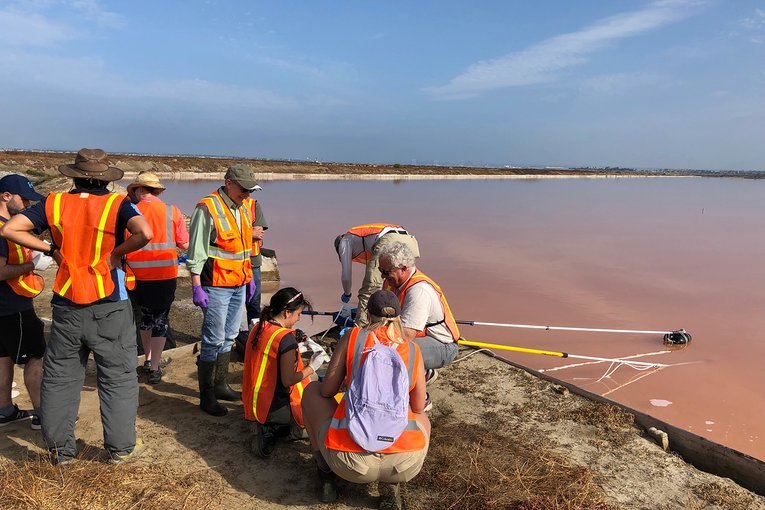
The Oceans Across Space and Time research team collected brine from South Bay Salt Works in California, USA, during an initial field trip in 2019.Image credit: Anne Dekas / Stanford University.
Scientists supported by NASA have determined just how salty water can be before single-celled organisms can no longer be active. The newly proposed limit for microbial activity in hypersaline environments is the first of its kind, and beyond the limit of microbial cell division accepted by the scientific community.
The researchers studied the growth and survival of nearly 6000 individual microbial cells from pools of evaporating seawater. Doing so allowed the team to examine how single cells survive as the water becomes saltier and the water activity (the availability of water for biological reactions) decreases. More than half of the cells remained active even after the saturation point of the salt sodium chloride (NaCl). Notably, as the waters became saltier, the heterogeneity (variation) in activity across the cells increased, even while the phylogenetic diversity of organisms present decreased, suggesting that physiological stress can cause an increase in phenotypic heterogeneity. Eventually, the environment became salty enough that no microbial activity could be detected, even though cell-like structures were still present.
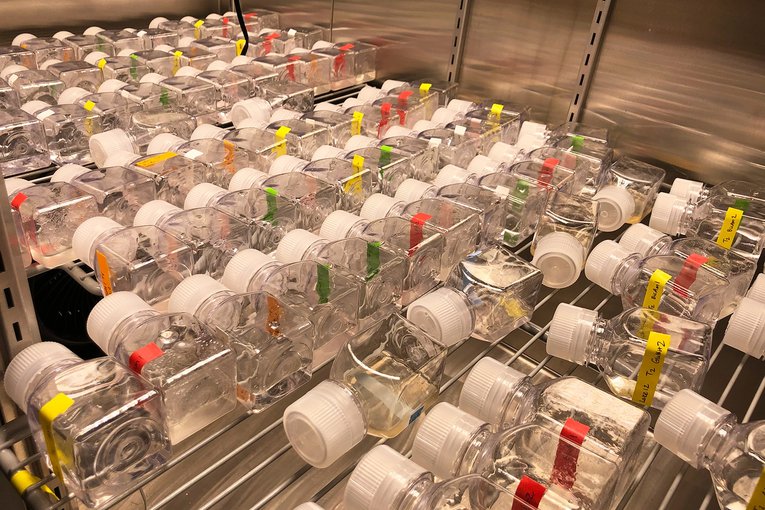
Bottles of brine incubate in a temperature and light-controlled chamber in the lab before scientists analyze the activities of the microbes inside.Image credit: Anne Dekas / Stanford University.
Ultimately, the researchers predict that the limit for detecting active cells is at a water activity of 0.540. This is much lower than what was previously thought possible, and expands our understanding of the potential habitable space available to life on Earth and beyond. The study also demonstrates how techniques for studying single-cell metabolism could be useful for detecting active life at the edge of habitability.
The study, “Single-cell analysis in hypersaline brines predicts a water-activity limit of microbial anabolic activity,” was published in the journal Science Advances.
Click here to read a press releases concerning this research from Stanford University.