

Aug. 24, 2018
Research Highlight
The Remnants of Magnetic Fields in Meteorites
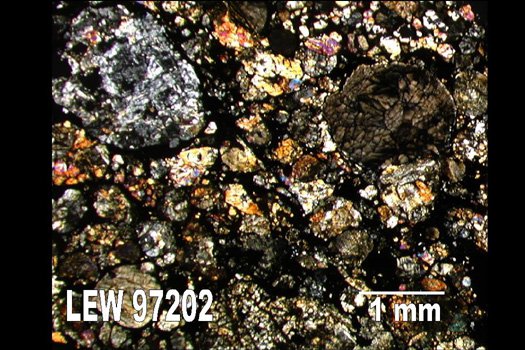
This thin section from the meteorite LEW 97202 exhibits numerous well-defined chondrules (up to 2 mm) in a black matrix of fine-grained silicates, metal and troilite.Image credit: NASA JSC, Tim McCoy.
When studying some stony meteorites, researchers are able to examine tiny, spheroidal mineral grains called chondrules to yield a great deal of information about the conditions in which the meteorite was formed. Scientists have even figured out how to determine the magnetic field strengths that chondrules were exposed to as they cooled following their formation. However, one question is whether or not this represents the background magnetic field of the solar nebula, or if the ancient magnetic field strengths were unique to the environment in which the chondrule was formed.
To study this question, researchers have examined two proposed mechanisms for chondrule formation, large-scale nebular shocks and planetary bow shocks; and how each of these mechanisms would have left their marks on chondrules. The results indicate that even if chondrules were melted in planetary bow shocks, they are more likely to contain a record of the background field of the solar nebula.
The study, “Magnetic Fields Recorded by Chondrules Formed in Nebular Shocks,” was published in the journal The Astrophysical Journal. This work was supported by the Emerging Worlds Program. The NASA Astrobiology Program provides resources for Emerging Worlds and other Research and Analysis programs within the NASA Science Mission Directorate (SMD) that solicit proposals relevant to astrobiology research.