

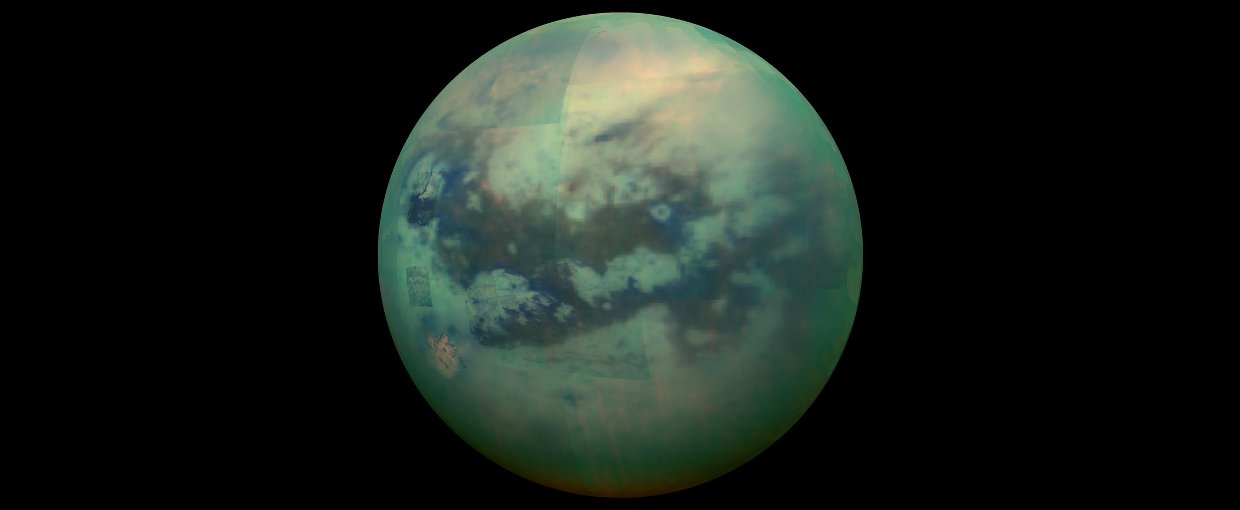
A false-color view of Titan, a moon of Saturn surrounded by a thick orange haze. Titan is believed to support a subsurface ocean beneath its surface.NASA/JPL-Caltech/SSI
A recent study proposes that Titan’s atmosphere may have had two sources of organics: photochemistry from above and core processing from below. Researchers have presented a new model for the origin the Saturnian moon’s atmosphere that includes the delivery of abundant organic material from cometary impacts. If the core of Titan had been warm, and outgassing from the core delivered organics to the subsurface ocean, this would have provided dual sources of organics for the moon’s dense atmosphere.
Click here to read a full article about the findings from ScienceNews.

Sunset on Saturn’s moon Titan reveals the atmosphere around the moon as seen from the night side with NASA’s Cassini spacecraft. Credit: NASA/JPL-Caltech/SSIImage credit: NASA/JPL-Caltech/SSI.
The study, “Contributions from Accreted Organics to Titan’s Atmosphere: New Insights from Cometary and Chondritic Data,” was published in the journal The Astrophysical Journal. The work was supported in part through the NASA Astrobiology Institute (NAI) element of the NASA Astrobiology Program.