
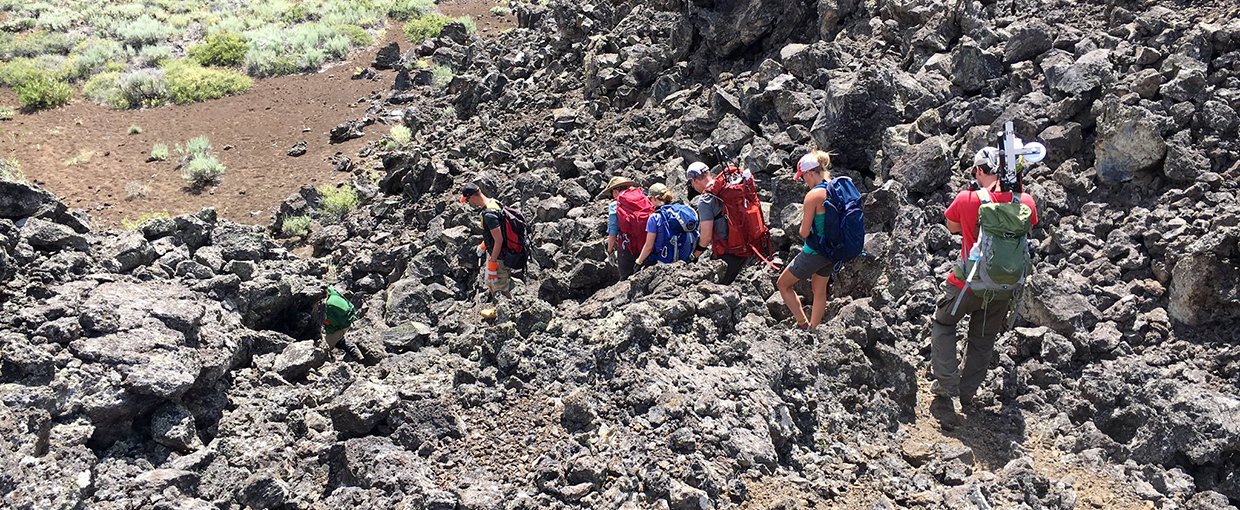
Members of the BASALT team after the final simulated EVA of the Idaho 2016 field season.BASALT

Astrobiology Volume 19 Issue 3, a Special Issue focused on NASA's Biologic Analog Science Associated with Lava Terrains (BASALT) research program.Image credit: Astrobiology, Vol 19, Issue 3 (March 2019).
The latest issue of the journal Astrobiology is a special collection of papers resulting from the NASA’s Biologic Analog Science Associated with Lava Terrains (BASALT) research program. Since the summer of 2015, the BASALT project has been simulating the human exploration of Mars in order to develop recommendations for extravehicular activities on future planetary missions that include both human and robotic explorers. The team includes scientists, engineers, mission operators, and astronauts.
The special issue of Astrobiology (Volume 19, Issue 3) was guest edited by Darlene Lim of the NASA Ames Research Center, and is available for free at:
https://www.liebertpub.com/toc/ast/19/3
Click here to read a release from Astrobiology.
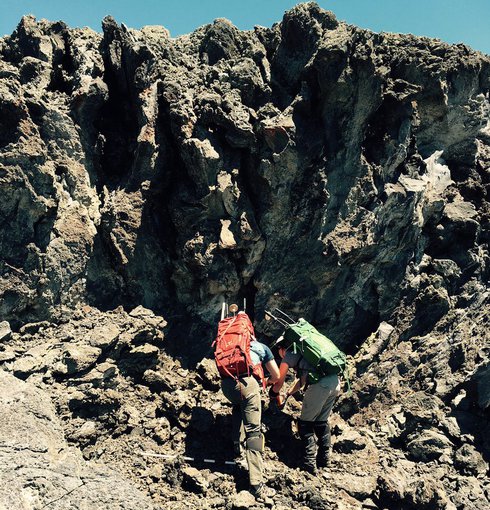
BASALT team members Shannon Kobs Nawotniak(green) Steve Chappell (orange) in the field.Image credit: BASALT.
The BASALT research program is supported by NASA Astrobiology through the the Planetary Science and Technology from Analog Research (PSTAR) program. PSTAR addresses the need for integrated interdisciplinary field experiments as an integral part of preparation for planned human and robotic missions. Furthermore, the program solicits proposals for investigations focused on exploring the Earth’s extreme environments in order to develop a sound technical and scientific basis to conduct astrobiological research on other solar system bodies.
The PSTAR solicitation is a consolidation of two previous calls: Astrobiology Science and Technology for Exploring Planets (ASTEP) and Moon Mars Analogue and Mission Activities (MMAMA).