Written byCharles Q. ChoiSource
astrobio.net


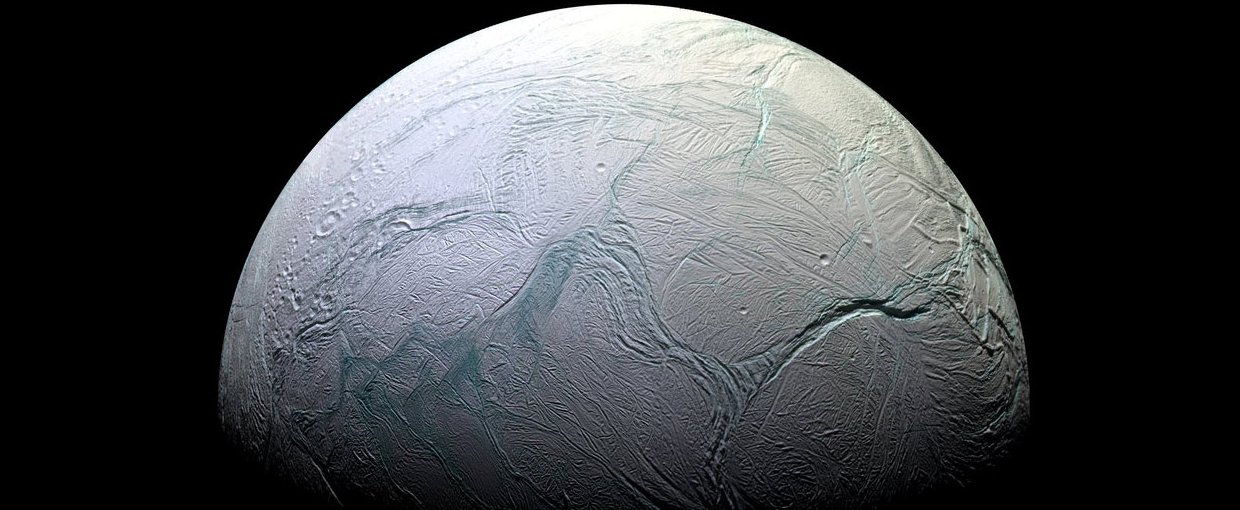
Tidal dissipation is usually most prominent in shallow oceans, while the ocean on Enceladus (a moon of Saturn) is believed to be tens of kilometers thick.NASA/JPL-Caltech/Space Science Institute
Microbes living at the edges of Arctic ice sheets could help researchers pinpoint evidence for similar microorganisms that could have evolved on Mars, the Jovian moon Europa, or Saturn’s moon Enceladus.
Scientists are investigating the receding edge of ice sheets on Earth to study the release of methane there.
Methane is a colorless, odorless, flammable gas. On Earth, some methane is produced abiotically — not by life — through reactions between water and rock, as well as through the breakdown of hydrocarbons by geological processes. On the other hand, some methane comes directly or indirectly from methanogenic microbes, as a byproduct of fermentation of acetate, a derivative of vinegar, into methane and carbon dioxide.
“It is increasingly clear that on Earth, there are cold-adapted methanogenic microbes in Arctic, Antarctic and sea-bottom settings,” said researcher Jeffrey White, an environmental biogeochemist at Indiana University. “Acetate fermentation is the principal pathway accounting for as much as 95 percent of methane production in these cold environments.”
Similar ice sheets exist elsewhere in the solar system, such as the buried water ice glaciers in the Hellas Basin region on Mars. The plan is to see what methods can best determine whether the sources of any such methane are alive or not.
Scientists are investigating the receding edge of ice sheets on Earth to study the release of methane there.
Methane is a colorless, odorless, flammable gas. On Earth, some methane is produced abiotically — not by life — through reactions between water and rock, as well as through the breakdown of hydrocarbons by geological processes. On the other hand, some methane comes directly or indirectly from methanogenic microbes, as a byproduct of fermentation of acetate, a derivative of vinegar, into methane and carbon dioxide.
“It is increasingly clear that on Earth, there are cold-adapted methanogenic microbes in Arctic, Antarctic and sea-bottom settings,” said researcher Jeffrey White, an environmental biogeochemist at Indiana University. “Acetate fermentation is the principal pathway accounting for as much as 95 percent of methane production in these cold environments.”
Similar ice sheets exist elsewhere in the solar system, such as the buried water ice glaciers in the Hellas Basin region on Mars. The plan is to see what methods can best determine whether the sources of any such methane are alive or not.
To analyze these microbes and their methane emissions, White and his colleagues recently went to Greenland as part of a $2.6 million NASAASTEP grant. They investigated the western edge of the Greenland ice sheet, “one of the most readily accessible margins of a large ice sheet on Earth,” White said. “The relatively manageable logistics and climate in Greenland compared to Antarctica made this area an excellent choice.”
Careful analysis of the isotopes making up methane can shed light on its origins. Isotopes are variants of elements. All isotopes of an element have the same number of protons in their atoms, but each has a different number of neutrons — for instance, atoms of carbon-12 each have six neutrons while atoms of carbon-13 have seven.
The available data suggests that methane from microbial reactions is substantially richer in lighter isotopes at 20 to 40 parts per thousand than abiotic methane, explained researcher Lisa Pratt, an astrobiologist and geomicrobiologist at Indiana University. Small dissolved molecules or ions containing a lighter isotope move more rapidly at a given temperature than ones containing a heavy isotope. Consequently, those containing a light isotope interact more often with a bacterium’s enzymes, and so get incorporated more often into what it makes, such as methane.
In 2011, the researchers used an infrared laser to look for methane at multiple sites across the valley that extends for tens of miles near the margin of the Greenland ice sheet. Measurements were taken about six feet (2 meters) above the soil surface for one to 4.5 hours each time.
Methane was spotted at several lakes and wetland areas. However, the methane levels seen were very close to what would be detected from normal atmospheric levels at ice margins in Greenland. Their next measurements will be taken at heights just above the soil surface to better distinguish local sources of emission.
So far the researchers have been surprised by how much biology and biogeochemistry can vary across several small lakes arrayed along a single valley near the ice margin. “If life was widespread during an early period on Mars when small lakes were common, we need to approach sampling with the expectation that pronounced variation in biological markers could occur even over distances as small as 100 meters (330 feet),” Pratt said.
In the coming summer, the researchers intend to look for potential subsurface gaseous signs of life with an innovative drill they have developed. The device allows rapid transfer of unaltered gas samples from drilled boreholes directly into analytical instruments. A similar instrument could one day find use in planetary exploration, Pratt said.