

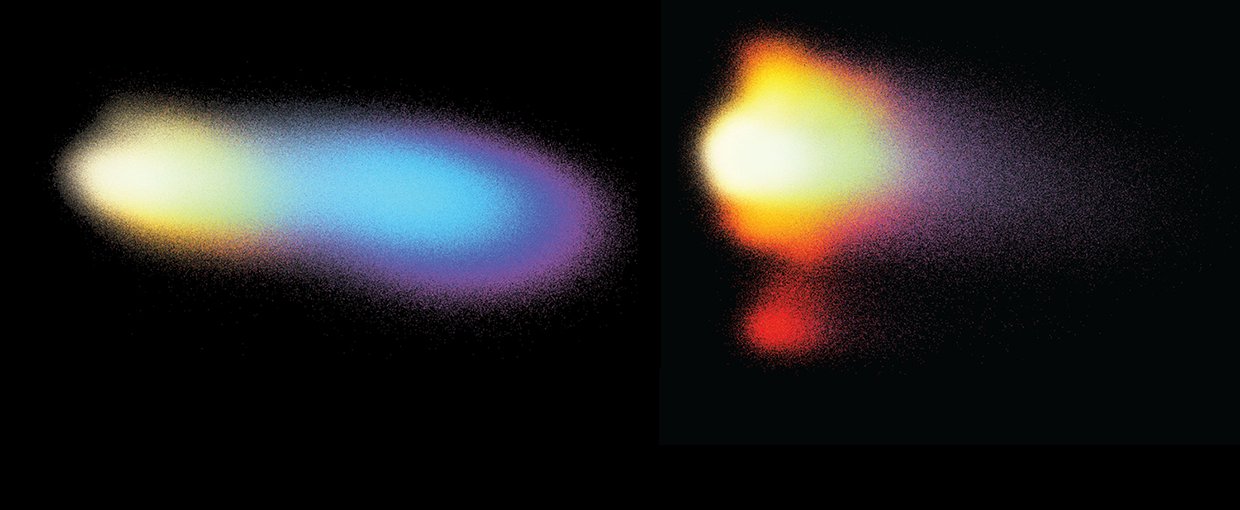
The dawn of evolution.During the early history of life, Darwinian evolution is thought to have been driven by RNA enzymes that catalyzed the replication of other RNA enzymes. Researchers have now demonstrated how a critical threshold of copying accuracy needed to be crossed, with low-fidelity copying resulting in the loss of functional information (left), and high-fidelity copying enabling the evolution of fitter molecules (right).
NASA-supported researchers have used a laboratory technique called directed evolution to create an RNA enzyme that is capable of carrying out RNA polymerase activity. In living cells, protein polymerases catalyze chemical reactions involved in the synthesis of RNA and DNA.
Deoxyribonucleic acid (DNA) is what we think of as the informational molecule in life today. It is composed of two chains of nucleic acids, the sequence of which acts as a blueprint for functional cells. Ribonucleic acid (RNA) is similar, but typically exists as a single strand of nucleotides. In many ways, RNA is simpler than DNA, which is one reason many scientists think that RNA likely came before DNA in the history of life on our planet (an idea known as the RNA World Theory).
The team observed how the artificial RNA enzyme they made in the lab worked and could be used to copy other RNA molecules. The enzyme was used to replicate and evolve other RNA enzymes that had improved fitness. Specifically, this involved an RNA enzyme capable of cutting strands of RNA (e.g. RNA-cleavage).

Researchers studying RNA enzymes that catalyzed the replication of other RNA enzymes demonstrated low-fidelity copying resulting in the loss of functional information (top), and high-fidelity copying enabling the evolution of fitter molecules (bottom).Image credit: David Horning, Nikos Papastavrou, and Gerald Joyce.
The experiment provides an example of RNA-catalyzed evolution of additional RNAs that are capable of carrying out different functions. Such a process is thought to have been used by life on early Earth, and could have been essential for life in an “RNA world” to evolve over time into the DNA-based life we’re familiar with today.
The study shows that heritable information was passed down from one generation to the next as RNA replicated over time, even as changes in the function of RNA were introduced. This demonstrates an RNA-based system that is able to evolve while still passing on heritable information. Such a system could have played an important role in the early history of life on Earth.
The team hopes that with further improvements to the technique, it could be used to learn about early life by constructing artificial cells in the laboratory that are based on RNA (rather than DNA and protein).
The paper, “RNA-catalyzed evolution of catalytic RNA,” was published in the Proceedings of the National Academy of Sciences (PNAS) of the United States of America.