

March 28, 2016
Feature Story
Ranking Exoplanets By Their Potential For Life
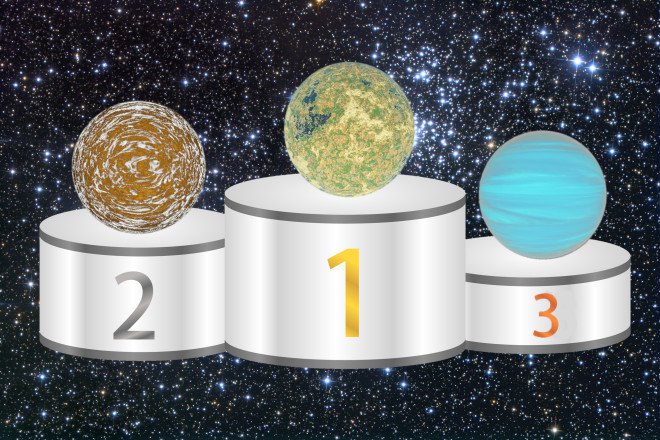
The Virtual Planetary Lab at the University of Washington has been working to rank exoplanets (or exoplanet candidates) by how likely they are to be habitable. (Rory Barnes/VPL)
Now that we know that there are billions and billions of planets beyond our solar system, and we even know where thousands of confirmed and candidate planets are located, how and where should we be looking for those planets most likely to be habitable? And, if we’re very smart and lucky in our searches, those most likely to actually support extraterrestrial life?
These quite new questions have given rise to one of the more daunting and consequential efforts in the field: identifying and ranking the relative habitability of the most intriguing targets.
The first order answer to the question of where to look is, of course, in the habitable zone – those regions around a host star that would allow orbiting planets to have liquid water on the surface at least some of the time. As colloquially described, it would be within a “Goldilocks zone” that is not too hot and not too cold.
This approach is by definition a theoretical one — at this point we have no firm detection of an exoplanet with liquid surface water orbiting a distant star. The Goldilocks approach also represents, perhaps surprisingly, a far from novel view.