

April 11, 2023
Research Highlight
Planetesimals and the Delivery of Water to the Early Earth
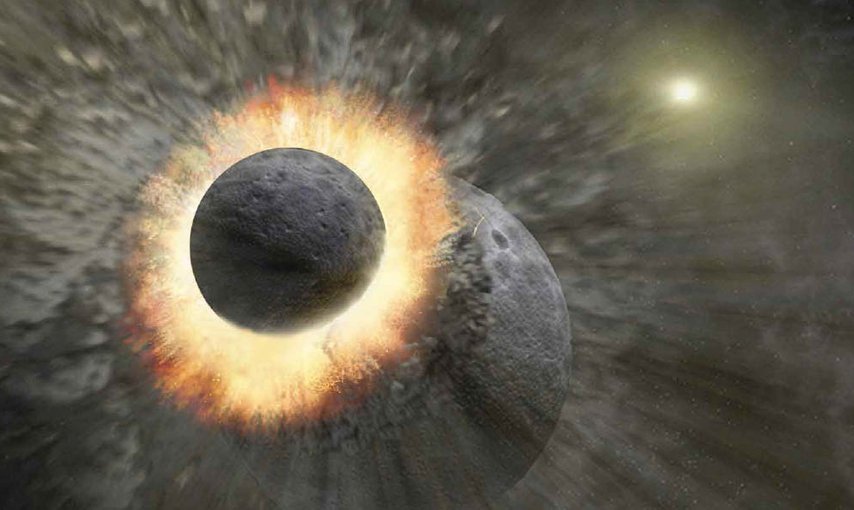
Artist impression of the Moon-forming event.Image credit: NASA/JPL-CalTech/T. Pyle.
A new study by NASA-supported scientists has shown that differentiated planetesimals may not have been a likely source of water for the early Earth. The timing and delivery of water to the early Earth is an important aspect in understanding how our planet became habitable for life.
Some researchers have theorized that large, differentiated planetesimals like the object responsible for the giant impact that formed the Moon could have delivered substantial amounts of volatiles, including water to the newly formed Earth billions of years ago. Others believe that smaller, undifferentiated objects are more likely carriers of such materials important for habitability.
The new study examines types of achondrite meteorites that are ancient pieces of mantle or crust from planetesimals in the early Solar System. The meteorites examined are ones that fell to Earth relatively recently and represent samples from both the inner and outer Solar System. The team found that all of these objects are extremely low in water content. The results suggest that differentiated planetesimals degassed most of their water through the process of their formation, and that such objects would not have delivered substantial amounts of water to the early Earth.
Click here to read a press release from the University of Maryland concerning this research.
The study, “Degassing of early-formed planetesimals restricted water delivery to Earth,” was published in the journal Nature.