

Nov. 7, 2017
Research Highlight
Peatland Diazotrophy
Peatland ecosystems are an important sink for atmospheric carbon dioxide (CO2), and are particularly susceptible to the Earth’s changing climate. These ecosystems receive an important contribution of biologically-available nitrogen from the microbial fixation of nitrogen gas (N2), a process known as diazotrophy.
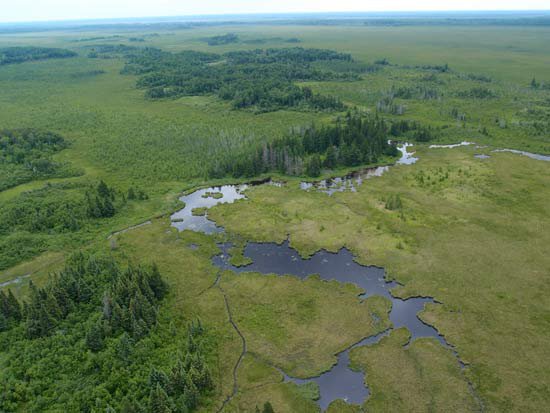
Arial view of peatland in northern Minnesota.Image credit: Minnesota DNR, Erika Rowe for the Minnesota Biological Survey (MBS).
In a recent study of a peat bog in Minnesota, scientists identified microbes responsible for mediating diazotrophy in the system, as well as the nitrogenase used by these microbes to fix nitrogen. The team also determined the effects of light, oxygen, CO2, and methane on rates of diazotrophy. The findings indicate that oxygen levels and photosynthetic activity may be more important than low nutrient availability in limiting diazotrphy in these types of environments. In addition, diazotrophy is catalyzed at the bog surface by microbes using a molybdenum-based form of the nitrogenase enzyme.
The paper, “Molybdenum-Based Diazotrophy in a Sphagnum Peatland in Northern Minnesota,” was published in the journal Applied and Environmental Microbiology. The work was supported by NASA Astrobiology through the Exobiology & Evolutionary Biology Program.