
March 2, 2018
Program News
Noah Planavsky Selected for the 2018 F. W. Clarke Award
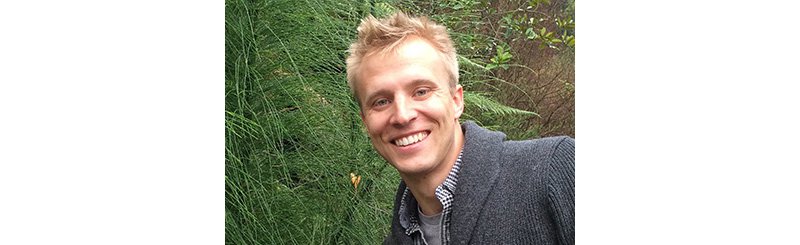
Noah Planavsky, PI for the Exobiology & Evolutionary Biology Program, will receive the 2018 F. W. Clarke Medal in August.Image credit: Yale University.
Noah Planavsky, Assistant Professor of Geology and Geophysics at Yale University, will receive the 2018 F.W. Clarke Award this summer. The Clarke Award recognizes an early-career scientist for a single outstanding contribution to geochemistry or cosmochemistry published either as a single paper or a series of papers on a single topic. Dr. Planavsky is recognized for his work on mid-Proterozoic oxygen levels, as defined by his novel application of the chromium (Cr) isotope proxy. The award will be formally presented at the 2018 Goldschmidt Conference in Boston this August.
For more, visit: https://www.geochemsoc.org/news/2018/02/26/noah-planavsky-named-2018-fw-clarke-medalist
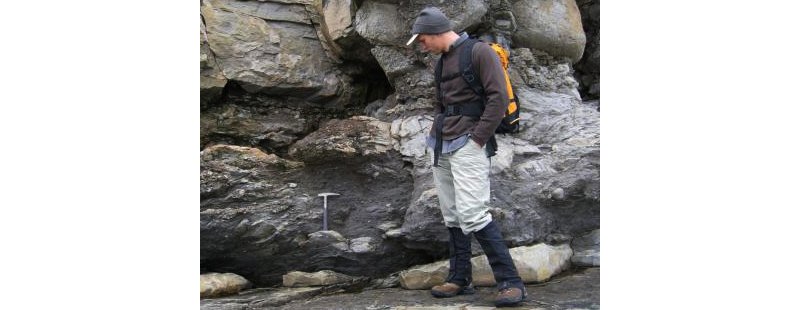
Noah Planavsky examines sedimentary rocks (diamictite) in Northern Norway that were deposited in the aftermath of one of the widespread 'Snowball Earth' glacial events.Image credit: Lyons lab, UC Riverside.
Planavsky is supported by the NASA Astrobiology Program through the Exobiology & Evolutionary Biology Program. He is also a member of the NASA Astrobiology Institute’s Alternative Earths and Foundations of Complex Life teams, as well as the Virtual Planetary Laboratory (VPL). Planavsky was a 2008 recipient of the Lewis and Clark Fund for Exploration and Field Research in Astrobiology. Planavsky is also an advisor for the NASA Astrobiology Postdoctoral Program.
Related Links:
Noah Planavsky Selected as a 2016 Alfred P. Sloan Fellow in Ocean Sciences