

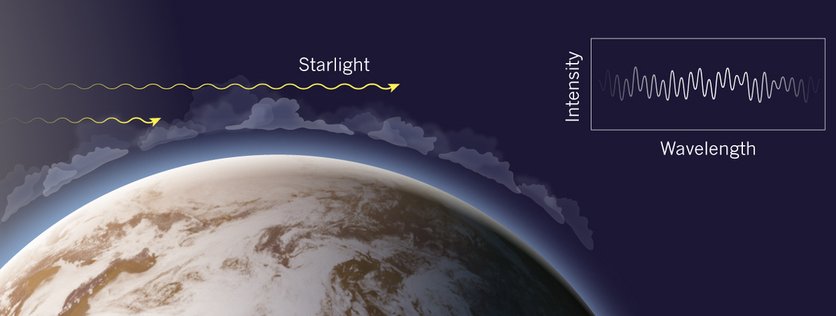
If starlight passing through a planetary atmosphere is blocked by clouds or haze, the resulting spectrum is flat and featureless, and no molecules or potential biomarkers are visible. Credit: Kempton, E.M.R., 2014, Nature, 513, 493. Used with permission
If life exists on planets beyond our Solar System, its presence could be obscured by the haze and clouds in the planet’s atmosphere.
Even next generation telescopes — such as the James Webb Space Telescope (JWST) as well as ground-based telescopes like the European Extremely Large Telescope (E-ELT) — will have a hard time penetrating such hazy worlds in search of biomarkers. Astronomers Amit Misra and Victoria Meadows of the University of Washington have developed a new technique to check if a planet has clear skies, which will make it easier for astrobiologists to target the most promising exoplanet candidates for life.
Their research has been published in the Astrophysical Journal Letters and was funded by the NASA Astrobiology Institute element of the Astrobiology Program at NASA.