

Dec. 12, 2017
Research Highlight
New Instrument for Measuring Nitric Oxide in Cells
A new microelectrode could help scientists study Nitric Oxide near the surface of living cells in the field.
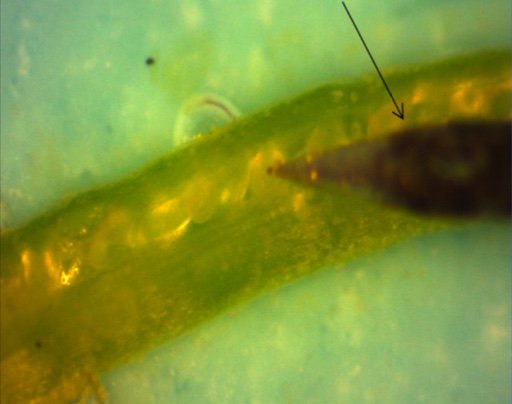
Photograph of SR Nitric Oxide microsensor near the surface of A. thaliana ovules after opening of the silique wall. Arrow indicates electrode.Image credit: Chaturvedi et. al. (2017), Analytical Methods, 2017,9, 6061-6072. DOI:10.1039/C7AY01964E.
Scientists have developed a microelectrode that could facilitate field studies on the dynamics of Nitric oxide (NO) near the surface of living cells and tissues. In many living cells, NO is used as a signalling molecule for many important processes, including cell development. However, obtaining real time measurements of NO in cells and tissues has been a challenge for researchers in the field. The new sensor could help solve this problem, and provides measurements similar to those obtained with laboratory microelectrode designs. To demonstrate the instrument’s use, the team of scientists examined three model organisms, including: bacteria, plant, and an invertebrate animal.
The study, “Microprofiling real time nitric oxide flux for field studies using a stratified nanohybrid carbon–metal electrode,” was published in the journal Analytical Methods. The work was supported by NASA Astrobiology through the Exobiology & Evolutionary Biology Program.