

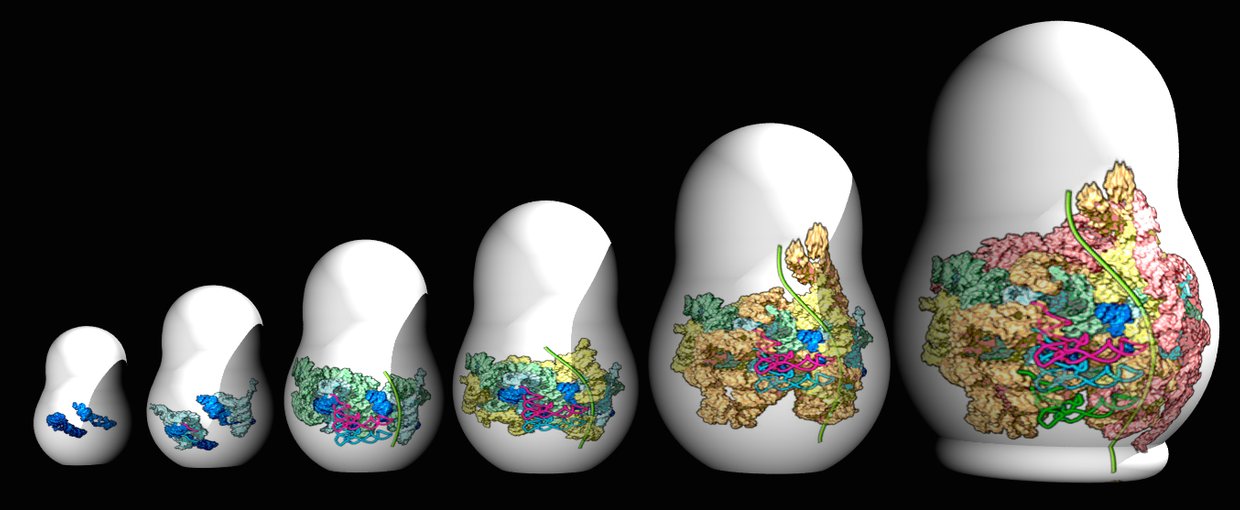
The ribosome grew by accretion of new RNA onto old RNA in a process reminiscent of nested Russian dolls. The most ancient part of the ribosome contains small RNA fragments and is represented by the smallest doll. Ever more recent additions to the ribosome increased its functionality, and are represented on dolls of increasing size. The largest doll displays the ribosomal RNA that is shared by all current forms of life. Nick Hud, Georgia Tech
NASA-funded researchers at the Georgia Institute of Technology are tapping information in the cells of all life on Earth, and using it to trace life’s evolution. They have learned that life is a master stenographer; writing, rewriting, and recording its history in elaborate biological structures.
Some of the keys to unlocking the origin of life lie encrypted in the ribosome, life’s oldest and most universal molecule. Today’s ribosome converts genetic information (RNA) into proteins that carry out various functions in an organism. But the ribosome itself has changed over time. Its history shows how simple molecules joined forces to invent biology, and its current structure records ancient biological processes that occurred at the root of the Tree of Life, some 3.8 billion years ago.
By examining variations in the ribosomal RNA contained in modern cells, scientists can visualize the timeline of life far back in history, elucidating molecular structures, reactions, and events near the biochemical origins of life.
The full press release is available at the Georgia Tech website.
The study is reported in the journal Proceedings of the National Academy of Sciences. The research was funded in part by the NASA Astrobiology Institute.
A video produced by Georgia Tech to accompany the published research explains the central dogma of molecular biology, molecular symbiosis, and the origin of the translation system.