

Feb. 28, 2019
Research Highlight
Life in Salty, High-Altitude Salt Flats in Argentina
Genome sequence from a halophilic, lithium-tolerant Actinobacterium
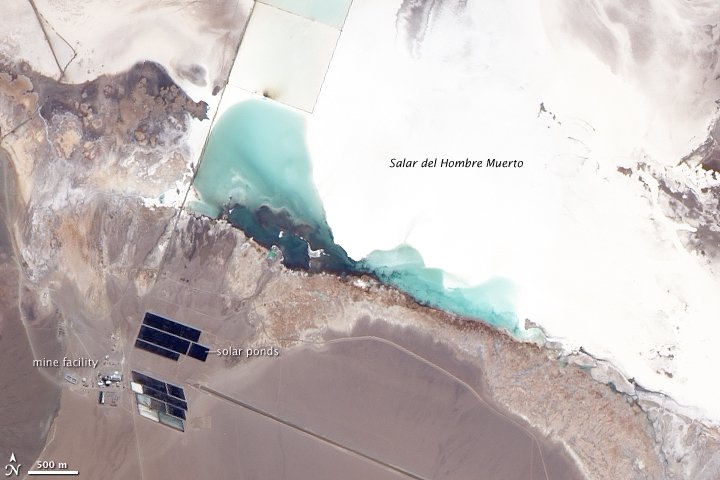
True-color image of the Salar del Hombre Muerto in northwestern Argentina. A salar is a salt pan, created when water repeatedly evaporates from a shallow lake, leaving behind a crusty layer of salt minerals, which are brilliant white in this image.Image credit: NASA (Image: Jesse Allen, using EO-1 ALI data provided by the NASA EO-1 Team; Caption: Holli Riebeek).
Astrobiologists working in Argentina have reported the complete genome sequence and methylome analysis of a halophilic (‘salt-loving’), lithium-tolerant Actinobacterium. Members of the phylum Actinobacteria are found in a wide range of terrestrial and aquatic habitats, including air, soil, and in humans. The strain used in the study, Micrococcus luteus SA211, originates from the Salar del Hombre Muerto, a hypersaline, lithium-rich, high-altitude salt flat in northwestern Argentina.
Studying microorganisms that thrive in harsh environments on Earth, including high salt concentrations, can help astrobiologists understand the mechanisms that life might use to survive on other worlds in our solar system. This research is used to inform how and where future missions might search for signs of past or present life beyond Earth.
The study, “Complete Genome Sequence and Methylome Analysis of Micrococcus luteus SA211, a Halophilic, Lithium-Tolerant Actinobacterium from Argentina,” was published in the journal Microbiology Resource Announcements. The work was supported by NASA Astrobiology through the Exobiology Program.