

Dec. 12, 2023
Research Highlight
It's a Trap! Salt and the Search for Biosignatures
NASA-supported researchers have provided a discussion of how halite (NaCl, or what is commonly known as table salt) could help preserve evidence of past environmental conditions and signs of life. The recent paper outlines how bedded halite (halite deposited on a planetary surface in lakes or oceans) is strongly influenced by the environmental conditions present when it was incorporated into rock.
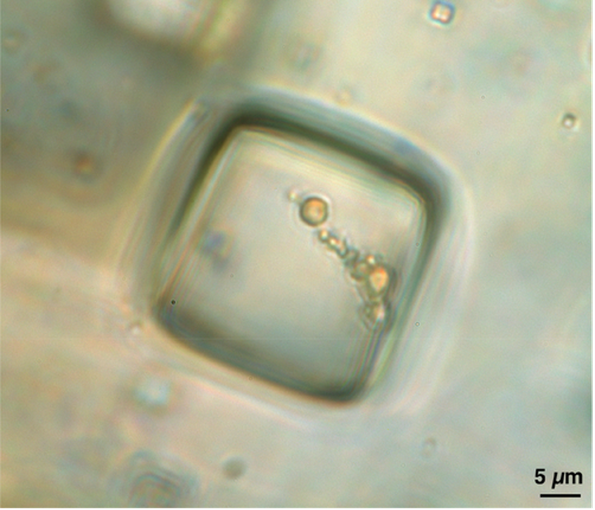
Algae and prokaryotes in primary fluid inclusion in halite from the Blaine Formation, Anadarko-Davis core, 429 m depth, from the subsurface of Kansas. Shown in plane transmitted light. Largest yellow algal cell is 5 microns in diameter.Image credit: Gibson, M.E. and Benison, K.C. (2023) DOI: 10.2110/jsr.2022.110.
Beds of halite in sedimentary rocks form when salty water evaporates and the salt collects at the bottom of the lake or seabed. If these salt deposits are undisturbed, they can preserve a myriad of data (including microorganisms, microfossils, organic compounds, and environmental data) over hundreds of millions of years. The team of scientists refers to halite as a ‘perfect trap’ due to many factors, including its rapid growth and its ability to encase organic material in both fluid inclusions and as solid inclusions in the interiors of crystals. This means that halite can provide ‘snapshots’ of the ancient hydrosphere, atmosphere, lithosphere, and biosphere over geologic time.
In the paper, the researchers present case studies that highlight the diversity of life that has been found within halite. The paper also discusses preservation properties of other salt minerals, such as gypsum. Finally, the team provides a discussion of the implications of halite preservation for astrobiology and recommendations for future studies of organic material in halite that would benefit from collaborations between chemical sedimentologists, paleontologists, and microbiologists.
The paper, “It’s a trap!: Modern and ancient halite as Lagerstätten,” was published in The Journal of Sedimentary Research.