

June 2, 2019
Research Highlight
Improving Methods for Analyzing Potassium Isotopes
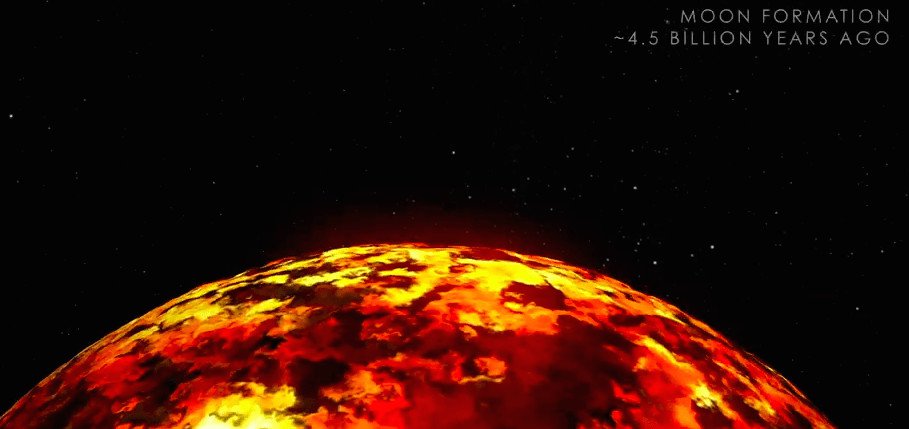
What the Moon may have looked like with an early magma ocean.Image credit: NASA/SVS/GSFC.
Researchers have reported an improved mass spectrometry technique for the study of potassium isotopes, which may provide insight into the history of lunar materials. The team analyzed the potassium isotope compositions of trinitite samples. The samples were formed during the first nuclear detonation at the Trinity test site in New Mexico on July 16, 1945. The explosion melted and evaporated arkosic sands at the site, forming glassy residues.
The team studied six bulk trinitite samples that were collected at different distances from ground zero. Under the extremely high temperatures caused by the detonation, the fractionation of potassium isotopes occurred through evaporation processes. However, when compared to similar studies on zinc in the same samples, isotopes of potassium showed far less fractionation. This result indicates that potassium is less volatile than zinc during planetary processes like degassing from magma oceans, volcanic outgassing, and impacts events. Because of this, the researchers believe that the enrichment of potassium isotopes in lunar rocks is likely a remnant of the initial Giant Impact event that formed the Moon.
The study, “Potassium isotope fractionation during high-temperature evaporation determined from the Trinity nuclear test,” was published in the journal Chemical Geology. This work was supported by the Emerging Worlds Program. The NASA Astrobiology Program provides resources for Emerging Worlds and other Research and Analysis programs within the NASA Science Mission Directorate (SMD) that solicit proposals relevant to astrobiology research.