

Aug. 25, 2016
Research Highlight
Global Warming, a Dead Zone, and Mysterious Bacteria
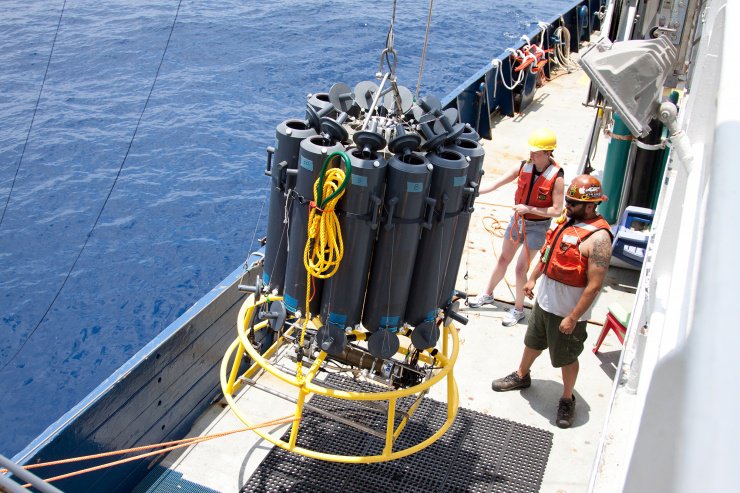
Researchers Liz Robertson from the University of Southern Denmark and Josh Manger from the University of California, San Diego, ready a sample collector. The carrousel of tubes dropped down 1,000 feet to an oxygen minimum zone off Mexico's Pacific coast. Credit: Dr. Heather Olins.
It’s natural for bacteria to deplete nitrogen in oxygen minimum zones (OMZs), ocean regions that have no detectable O2. But as climate change progresses, OMZs are ballooning, and that depletion is on the rise, drawing researchers to study it and possible ramifications for the global environment.
Now, a team led by the Georgia Institute of Technology has discovered members of a highly prolific bacteria group known as SAR11 living in the world’s largest oxygen minimum zone. The team has produced unambiguous evidence that the bacteria play a major role in denitrification.
Read the full story at the Georgia Tech website.
The researchers published their findings in the journal Nature. They produced genomic and enzyme analyses that pave the way for further study of carbon and nitrogen cycles in oxygen minimum zones.
The research has been funded by the National Science Foundation, the NASA Exobiology Program, the Sloan Foundation and the U.S. Department of Energy.