

Sept. 28, 2018
Research Highlight
Genome Comparison of Spore-forming Bacteria from Spacecraft Cleanrooms
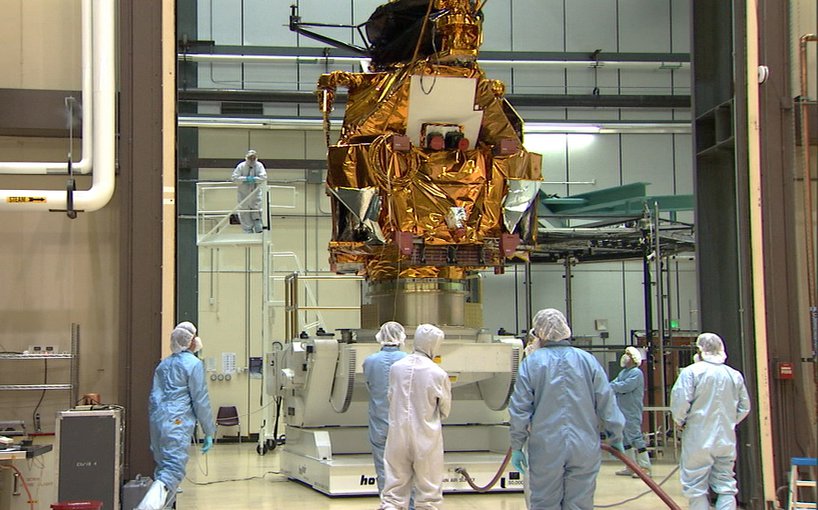
A group of engineers and technicians watch as the Mars Reconnaissance Orbiter is lifted in a cleanroom at Lockheed Martin in Littleton, Colorado during the orbiter's assembly, test and launch operations phase.Image credit: NASA/JPL.
Researchers have compared the genome sequences of bacterial isolates from cleanrooms and space craft assembly facilities. Some Bacillus strains produce spores that can be highly resistant to cleaning procedures, and are an important consideration in developing effective planetary protection procedures. For instance, one strain used in the study, Bacillus safensis strain FO-36b, produces spores that are resistant to both peroxide and radiation. By studying the details of the genome, scientists hope to gain a better understanding of how these organisms are able to survive as spores under harsh conditions, which could inform strategies for making sure that spacecraft on future missions can be sufficiently protected from contamination.
The study, “Bacillus safensis FO-36b and Bacillus pumilus SAFR-032: a whole genome comparison of two spacecraft assembly facility isolates,” was published in the journal BMC Microbiology. The work was supported by NASA Astrobiology through the Exobiology Program.