

Oct. 19, 2018
Research Highlight
Ediacaran Scavenging as a Prelude to Predation
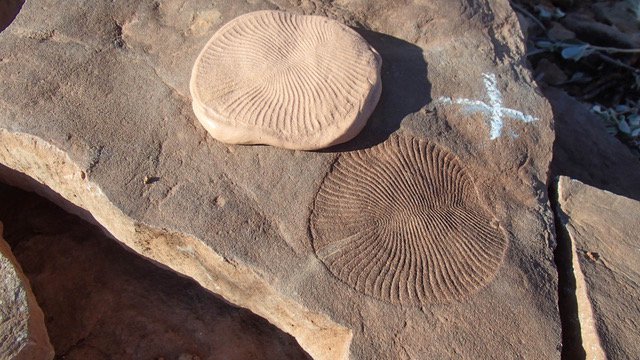
Dickinsonia costata, one of the most common species of the Ediacaran period, moved and fed on seafloor microbe mats. This specimen and its silly putty cast are about 6 centimeters across and from the Nilpena Station of South Australia.Image credit: Mary Droser.
Researchers have discovered the oldest known evidence of one ecology’s most fundamental ecological and evolutionary drivers, scavenging. The work resulted from studied of Ediacara Biota from South Australia. The ‘Ediacara Biota’ refers to a collection of fossils that compromise the oldest complex ecosystem on Earth for which we have physical evidence. These fossils also provide evidence of the earliest known radiation of animal life on Earth.
The Ediacara Biota included soft-bodied marine animals like Dickinsonia, Aspidella, and Funisia. The recent study identified scavenging of these organisms by seafloor, mat-burrowing animals. The researchers posit that these mat-burrowing animals were omnivorous and grazed on microbial mats. However, when mats were covered with thin layers of sand, the burrowers had to scavenge other dead animals. The results of this burrowing activity left behind trace fossils dubbed, Helminthoidichnites isp. The researchers believe that this could represent a fundamental ecological innovation, which could have affected the course of life’s evolution.
The study, “Ediacaran scavenging as a prelude to predation,” was published in the journal Emerging Topics in Life Sciences. The work was supported by NASA Astrobiology through the Exobiology Program.