

July 12, 2018
Research Highlight
Distinguishing Between Bacterial and Eukaryotic Sterols
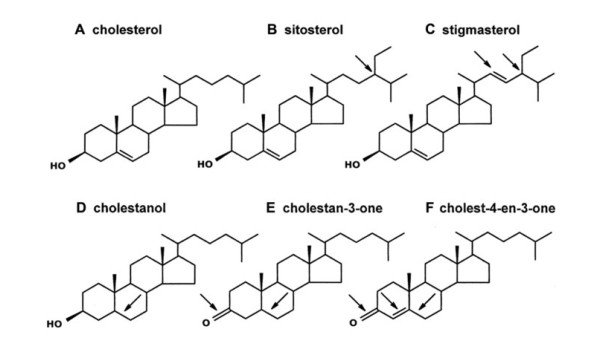
An example of sterols found in plants. Sterols are a subgroup of steroids, and are found in animals, plants, fungi, and some bacteria. Fossilized sterols can be preserved in sedimentary rock for billions of years.Image credit: Behmer et. al. (2013). DOI: 10.3389/fpls.2013.00370.
Sterols are lipids that can be preserved in sedimentary rocks as steroids for billions of years. Today on Earth, most sterols are produced by eukaryotic organisms. Because of this, sterols have been used as biomarkers for the presence of eukaryotes in ancient environments on our planet. However, sterols are also produced by a small number of bacteria. In a recent study, researchers used bioinformatics and lipid analyses to study how bacterial sterols are made. They identified bacterial sterol synthesis proteins, and showed that there are aspects of the bacterial sterol synthesis pathway that are distinct from eukaryotes. The study could have implications in interpreting geological evidence of fossilized sterols.
The paper, “C-4 sterol demethylation enzymes distinguish bacterial and eukaryotic sterol synthesis,” was published in the Proceedings of the National Academy of Science of the United States (PNAS)/em>. The work was supported by NASA Astrobiology through the Exobiology Program.