

Feb. 26, 2018
Research Highlight
Disk Masses from ALMA Continuum Observations
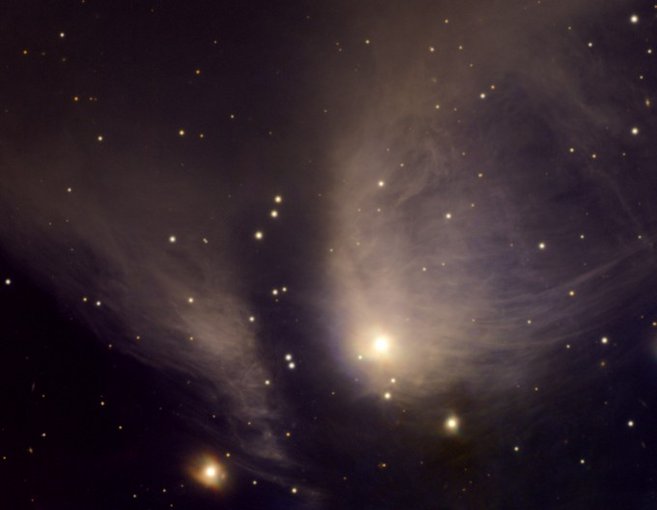
A star emerges from its natal cloud of gas and dust in this tantalizing portrait of RY Tauri, a small stellar nursery at the edge of the Taurus molecular cloud.Image credit: Gemini Observatory, Club d'astronomie de Dorval, S. Cote (HIA), T. Rector (U. Alaska).
Astronomers using data from the Atacama Large Millimeter/submillimeter Array (ALMA) have provided new insight into the distribution of mass in 24 systems from the Taurus star-forming region. ALMA continuum measurements of circumstellar disks around low-mass stars and brown dwarfs were converted to masses of dust using standard scaling laws and radiative transfer models. The results reveal trends in the relationship between the mass of dust in the planet-forming disk versus the mass of the central star. Data was also compared to members from other star-forming regions, including the older Upper Scorpius region. The results provide insight into why relatively few giant planets have been found orbiting M dwarfs.
The study, “The Taurus Boundary of Stellar/Substellar (TBOSS) Survey. II. Disk Masses from ALMA Continuum Observations,” was published in The Astronomical Journal. The work was supported in part by the Nexus for Exoplanet System Science (NExSS). NExSS is a NASA research coordination network supported in part by the NASA Astrobiology Program. This program element is shared between NASA’s Planetary Science Division (PSD) and the Astrophysics Division.