

Nov. 3, 2015
Research Highlight
Dating Meteor Impacts Requires More Data
A new study of zircon calls to question the dating methods and limited evidence that have been used to assume the dates of meteor crashes on the early moon and Earth. The story was published by the University of Wisconsin-Madison.
Scientists at UW-Madison looked at zircon from the Vredefort crater in South Africa where the meteor collision is estimated to have occurred around 2 billion years ago. While the zircon showed signs of shock from impact, the observed ages did not reflect the age of the incident so much as the age of the magma rocks the zircon formed inside. This has lead to the assertion that more context is needed before the measured age of lunar or terrestrial zircon, stripped out of rocks, can be directly correlated with time of impact.
The study, “A terrestrial perspective on using ex situ shocked zircon to date lunar impacts,” was published in Geology and funded by the NASA Astrobiology Institute, the National Science Foundation, and the
SHRIMP and Microscopy and Microanalysis facilities at Curtin University, Australia.
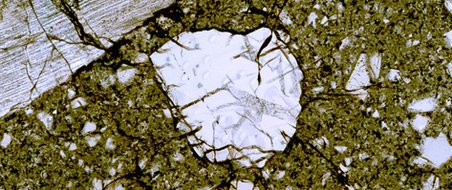
Lunar zircon brought back by astronauts from the Apollo 17 mission. Photo credit: Apollo 17/Nicholas E. Timms.