

April 30, 2019
Research Highlight
Contamination in Transmission Spectra
Effects of stellar contamination in spectra from broadly Sun-like stars
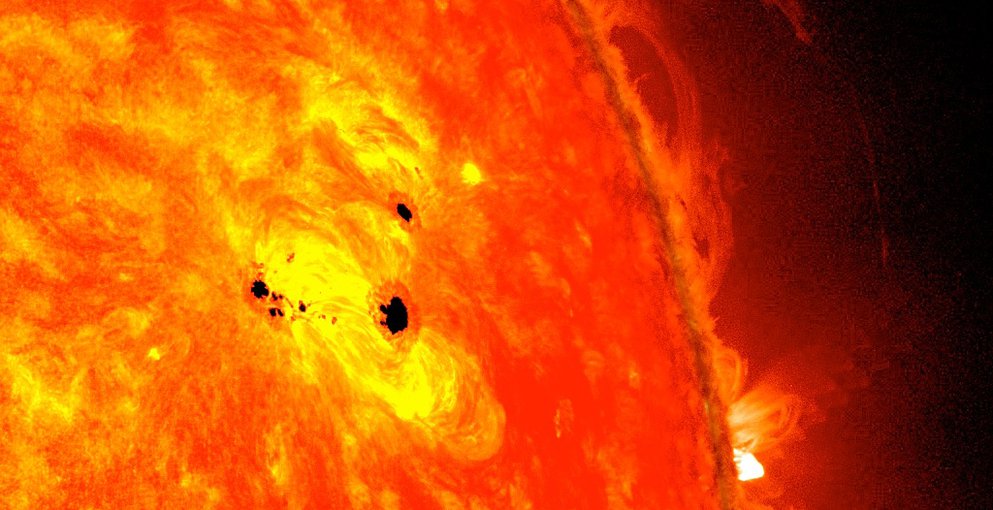
Like the Sun, the photospheres of stars that host exoplanets are not uniform. They can have bright and dark spots that might affect the transmission spectra that we receive from them.Image credit: NASA/SDO/AIA/HMI/Goddard Space Flight Center.
Astrobiologists have reported new information on the study of transmission spectra of exoplanet atmospheres. The study explores how stellar features (specifically faculae (bright spots) and unocculted spots) could effect the interpretation of spectra gathered during the transits of extrasolar planets. The researchers expanded on previous work that focused on M-dwarf transmission spectra, extending the analysis to FGK dwarfs (stars relatively similar to the Sun).
In general, stellar contamination spectra in FGK dwarfs appears to be less of an issue than for a typical M dwarfs. Inactive FGK dwarfs do not produce detectable features while active FGK dwarfs do. This means that more care must be taken in interpreting transmission spectra from active FGK dwarf systems.
The study, “The Transit Light Source Effect. II. The Impact of Stellar Heterogeneity on Transmission Spectra of Planets Orbiting Broadly Sun-like Stars,” was published in The Astronomical Journal. The work was supported by the Nexus for Exoplanet System Science (NExSS). NExSS is a NASA research coordination network supported in part by the NASA Astrobiology Program. This program element is shared between NASA’s Planetary Science Division (PSD) and the Astrophysics Division.