Written byAndrzej Pohorille


Aug. 16, 2007
Feature Story
Potential Origin of Primordial Protein Enzymes
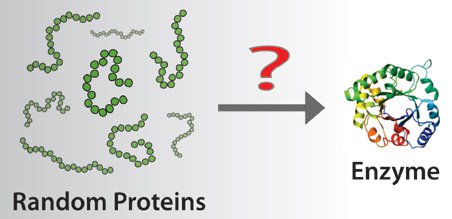
Life on earth is facilitated by a multitude of enzymes that catalyze essential chemical reactions. The vast majority of today’s enzymes are proteins, yet looking at the complex and intricate structures of natural enzymes it is hard to imagine how the first enzymes emerged.
However, new experiments by Seelig and Szostak, show that small, simple enzymes can evolve rather easily. In the August 16, 2007 issue of Nature, they describe the generation of an artificial enzyme by simulating evolution in a test tube. The researchers at first produced a random library of 4 trillion small protein molecules that were all slightly different from each other and then isolated a new enzyme by subjecting those protein molecules to an in vitro process of selection and evolution. In a matter of a few weeks this procedure yielded the novel enzyme. This enzyme, an RNA ligase, catalyzes the joining of two RNA molecules – a reaction for which no natural enzymes are known.
This study presents a potential scenario for the origin of the earliest biopolymers that facilitated the chemical reactions supporting life. The successful creation of novel enzymes that are not derived from biological proteins sheds new light on the potential of life beyond earth.