

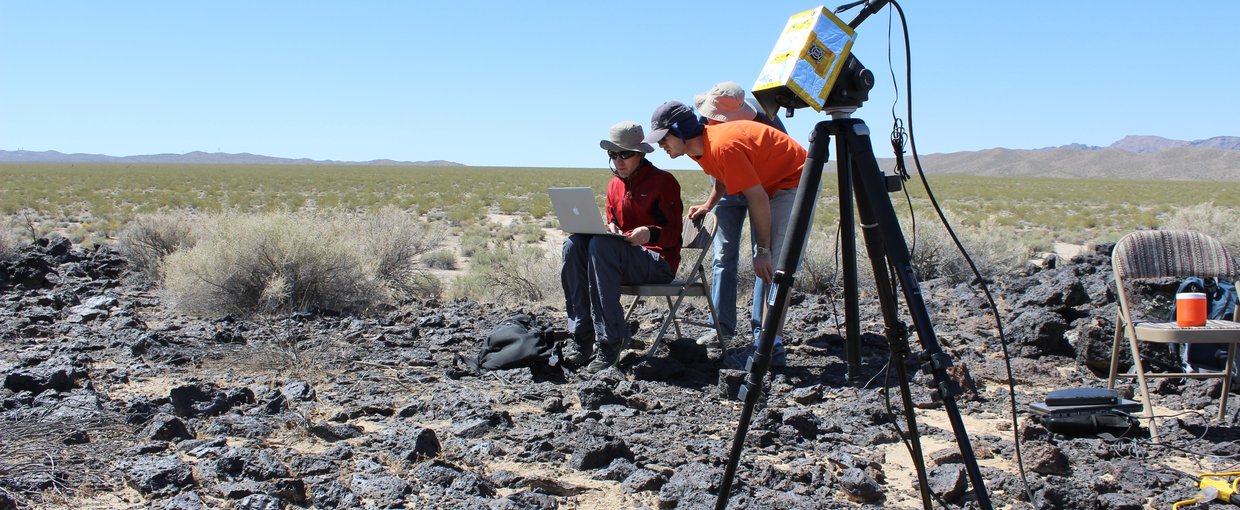
TextureCam analyzes rocks in the Mojave Desert that resemble rocks it may one day be called to identify on Mars. Credit: Kiri Wagstaff
Source: [astrobio.net]
The next mission to Mars could carry a smarter rover that is able to make better decisions absent instructions from Earth. Engineers are looking to automate some of the simple decision-making steps undertaken by rovers and orbiters, which could dramatically improve the science they are able to perform in the search for habitable environments.
This is the focus of the TextureCam Intelligent Camera Project, a NASA system that enhances autonomous investigations. TextureCam will allow the rover or satellite to better prioritize the data it sends to Earth, but it isn’t meant to take the place of human scientists.
A paper discussing the most recent test results performed by TextureCam, “Spatio-spectral exploration combining in situ and remote measurements,” has been submitted for publication in the Journal of Artificial Intelligence Research. A previous publication, “Field Demonstration of an Instrument Performing Automatic Classification of Geologic Surfaces,” can be found in the journal Astrobiology
The TextureCam project is supported by the NASAAstrobiology Science and Technology Instrument Development program.