

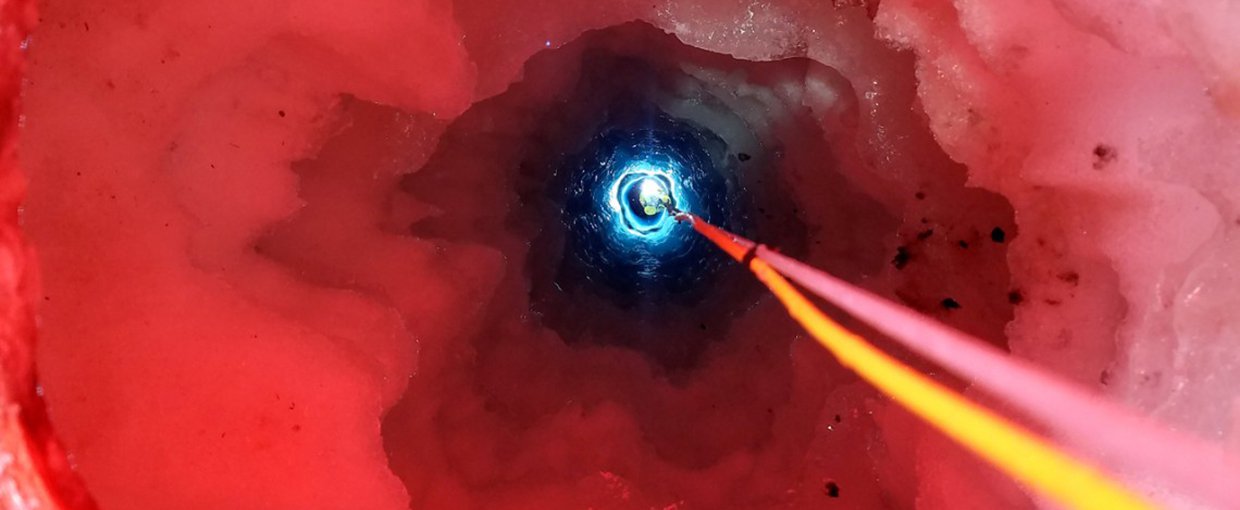
The remotely operated underwater vehicle Icefin is visible as it is lowered via a 4.3-mm fiber-optic tether through a borehole to start one of three dives beneath the Ross Ice Shelf. A tent shelter’s color is reflected in the ice.Icefin/NASA PSTAR RISE UP/Schmidt/Quartini
Britney Schmidt (Cornell University) has been named along with her colleague Peter Davis (British Antarctic Survey) to the 2023 TIME 100 list of most influential people in recognition for their contributions to climate science.
Earlier this year, the research team published first-of-its-kind data gathered from beneath the Thwaites Glacier in West Antarctica using the remotely operated vehicle, Icefin. NASA supported Schmidt and her team to develop the Icefin underwater robot through the Planetary Science and Technology from Analog Research (PSTAR) program. While Icefin was developed to test technology for NASA missions, this technology also has wider applications for other agencies and institutions. In Antarctica, Icefin was used to make critical observations of a rapidly changing glacier that is vulnerable to Earth’s changing climate.

Britney Schmidt in the field.Image credit: Peter Kimball.
As part of the US-UK International Thwaites Glacier Collaboration, the researchers used hot water to drill 600 meters through the ice, then lowered Icefin down to the water below. Icefin used its sensors to collect data from the underside of the glacier. The results show how a warming ocean drives rapid melting, widening crevasses and contributing to the breakup of the glacier.
The results from Thwaites Glacier are described in the paper “Nature, and a companion paper “Suppressed basal melting in the eastern Thwaites Glacier grounding zone”target=”_blank”>Heterogeneous melting near the Thwaites Glacier grounding line” in the same issue.
Ask an Astrobiologist: Robot Explorers on Icy Worlds with Dr. Britney Schmidt
The TIME100 was first published in 1999 and recognizes the impact, innovation, and achievement of influential individuals around the world.

Dr. Britney Schmidt discusses the search for life in the Solar System and beyond during an event at AbSciCon 2015.Image credit: NASA Astrobiology.