

May 6, 2019
Research Highlight
Ashes of a Dying Star Hold Clues about Solar System's Birth
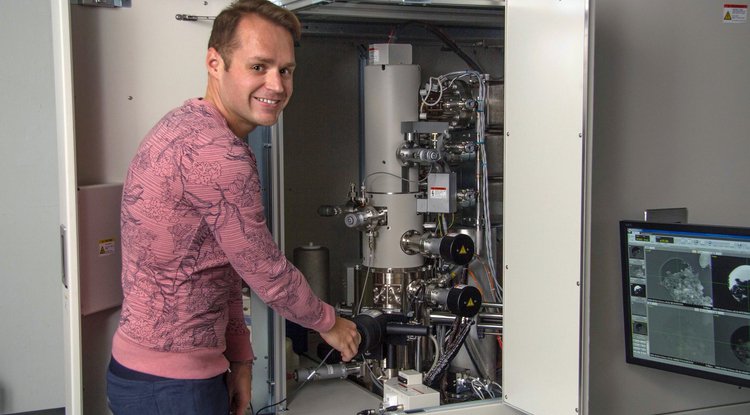
Pierre Haenecour, the study's lead author, is pictured with one of the ultra-high-resolution electron microscopes used to obtain chemical and microstructural information about the stardust grain.Image credit: Maria Schuchardt/University of Arizona.
From the University of Arizona:
A dust grain forged in a stellar explosion predating our solar system reveals new insights about how stars end their lives and seed the universe with the building blocks of new stars and planets.
A grain of dust forged in the death throes of a long-gone star was discovered by a team of researchers led by the University of Arizona.
The discovery challenges some of the current theories about how dying stars seed the universe with raw materials for the formation of planets and, ultimately, the precursor molecules of life.
Tucked inside a chondritic meteorite collected in Antarctica, the tiny speck represents actual stardust, most likely hurled into space by an exploding star before our own sun existed. Although such grains are believed to provide important raw materials contributing to the mix from which the sun and our planets formed, they rarely survive the turmoil that goes with the birth of a solar system.
“As actual dust from stars, such presolar grains give us insight into the building blocks from which our solar system formed,” said Pierre Haenecour, lead author of the paper that was published in Nature Astronomy. “They also provide us with a direct snapshot of the conditions in a star at the time when this grain was formed.”
Click here to read the full press release from the University of Arizona.
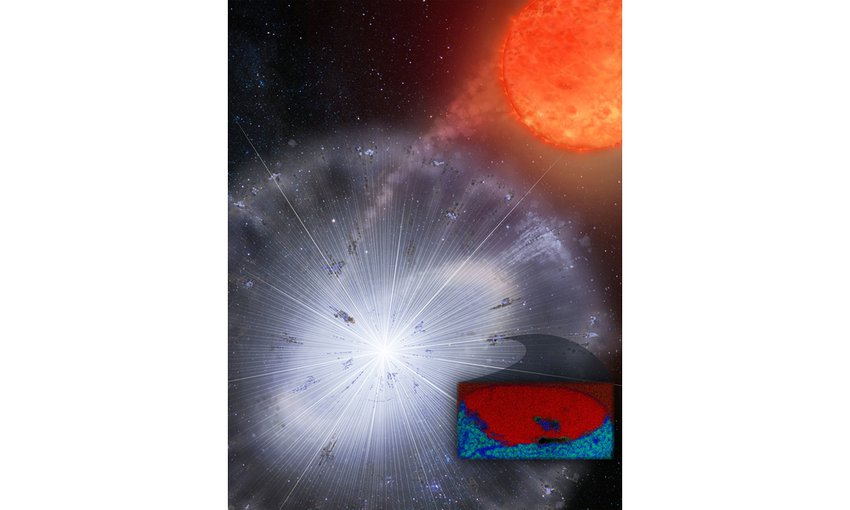
A team of researchers found a grain (inset image) encased in a meteorite that survived the formation of our solar system and analyzed it with instruments sensitive enough to identify single atoms in a sample. Measuring 1/25,000th of an inch, the carbon-rich graphite grain (red) revealed an embedded speck of oxygen-rich material (blue), two types of stardust that were thought could not form in the same nova eruption.Image credit: HEATHER ROPER/UNIVERSITY OF ARIZONA.
The study, “Laboratory evidence for co-condensed oxygen- and carbon-rich meteoritic stardust from nova outbursts,” was published in Nature Astronomy. The work was supported by the Nexus for Exoplanet System Science (NExSS). NExSS is a NASA research coordination network supported in part by the NASA Astrobiology Program. This program element is shared between NASA’s Planetary Science Division (PSD) and the Astrophysics Division.