

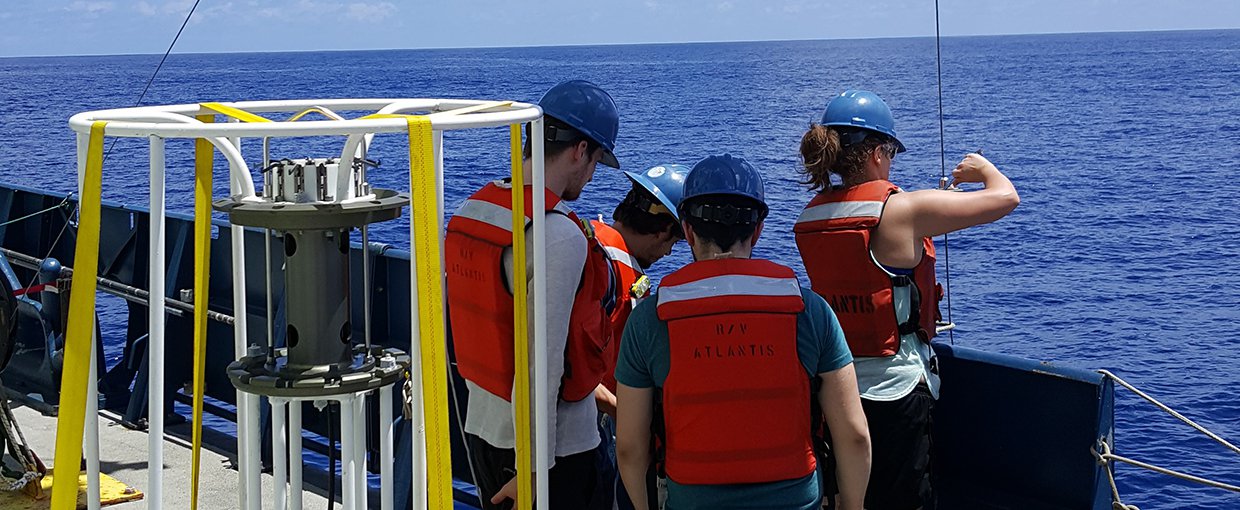
Jaclyn Saunders (far right) fixes the line on a McLane instrument that pumps large volumes of seawater in order to extract the DNA. The instrument on the left measures properties such as temperature, salinity and depth and collects smaller samples of seawater.Noelle Held/Woods Hole Oceanographic Institution

A purple arsenic atom surrounded by four oxygen atoms is arsenate (left). An arsenic atom surrounded by three oxygen atoms is arsenite (right). The study found marine organisms that convert one to the other to get energy in oxygen-deficient environments.Image credit: Wikimedia.
From the University of Washington
Arsenic is a deadly poison for most living things, but new research shows that microorganisms are breathing arsenic in a large area of the Pacific Ocean. A University of Washington team has discovered that an ancient survival strategy is still being used in low-oxygen parts of the marine environment.
“Thinking of arsenic as not just a bad guy, but also as beneficial, has reshaped the way that I view the element,” said first author Jaclyn Saunders, who did the research for her doctoral thesis at the UW and is now a postdoctoral fellow at the Woods Hole Oceanographic Institution and the Massachusetts Institute of Technology.
The study was published in the Proceedings of the National Academy of Sciences. The research was supported by a graduate fellowship from NASA and a research grant from the National Science Foundation.
Click here to read the full press release from the University of Washington.
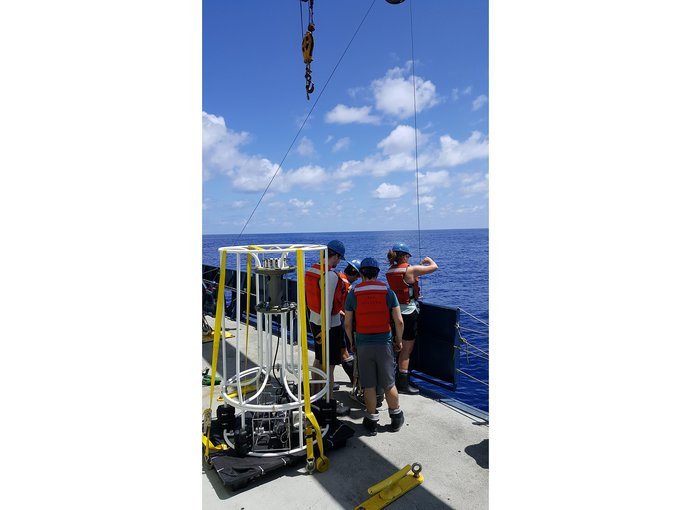
Jaclyn Saunders (far right) fixes the line on a McLane instrument that pumps large volumes of seawater in order to extract the DNA. The left instrument measures properties such as temperature, salinity and depth and collects smaller samples of seawater.Image credit: Noelle Held/Woods Hole Oceanographic Institution.