
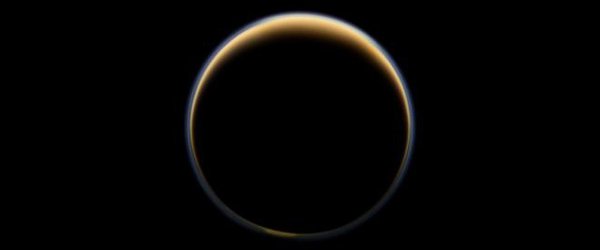
Sunset on Saturn’s moon Titan reveals the atmosphere around the moon as seen from the night side with NASA’s Cassini spacecraft.NASA/JPL-Caltech/SSI
A recent laboratory study provides new insight into the atmospheric production of aerosols on Titan. Scientists used photochemistry and several mixtures of methane (CH4) and nitrogen gas (N2) to generate analogs of organic aerosols found in Titan’s atmosphere. The team analyzed the fractionation of carbon and nitrogen found in the aerosols they produced, providing clues as to how organic aerosols on Titan could ask as a sink for these major elements.
Studying how stable isotopes of major elements like carbon and nitrogen form through organic chemistry on Titan could help astrobiologists better understand local and global processes on the moon.
Support for this research was provided by the NASA Astrobiology Program through NASA’s Solar System Workings element and the NASA Astrobiology Institute’s Virtual Planetary Laboratory. Additional support came from NASA grants from the Planetary Atmospheres element, Outer Planets Research element, and the NASA Postdoctoral Program at the Goddard Space Flight Center, administered by Oak Ridge Associated Universities through a contract with NASA.
The work was presented at the 47th Division of Planetary Sciences meeting of the American Astronomical Society, and the 2015 European Planetary Science Congress.
The paper “13C and 15N fractionation of CH4/N2 mixtures during photochemical aerosol formation: Relevance to Titan,” was published in the journal Icarus.