

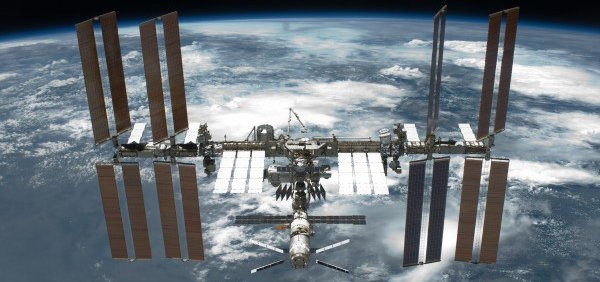
Microbes survived on the exterior of the International Space Station for nearly two years, if their UV radiation was limited or eliminated. Credit: NASA
Microbes Can Survive In Meteorites If Shielded From UV Radiation
Source: [astrobio.net]
Understanding how well microbes can survive in space is of importance when sending out orbiters or landers around bodies that might present the right conditions for life, such as Mars. Scientists want to be careful to avoid contaminating other worlds with life from our own. And microbes’ resilience to Outer Space enhances the prospects of panspermia, in which life can be seeded between planets via meteors and other traveling bodies.
This basis formed part of the rationale for a study supported by the NASA Astrobiology Institute (NAI). Researchers took pure cultures of two salt-loving microbes from solid salt crusts and grew them. After drying them, some of the samples were sent to the International Space Station’s external platform space exposure facility, called EXPOSE-R. Those microbes remained on the exterior for nearly two years. Surprisingly, some survived when they were protected from UV radiation.
The study, “The affect of the space environment on the survival of Halorubrum chaoviator and Synechococcus (Nägeli): data from the Space Experiment OSMO on EXPOSE-R,” was published in the International Journal of Astrobiology.