

Oct. 26, 2017
Feature Story
2.5 Billions Years of Earth History in 100 Square Feet
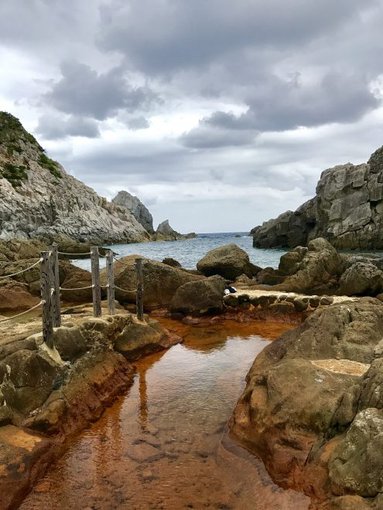
Scalding hot water from an underground thermal spring creates an iron-rich environment similar to what existed on Earth 2.5 billion years ago. (Nerissa Escanlar)
Along the edge of an inlet on a tiny Japanese island can be found– side by side – striking examples of conditions on Earth some 2.4 billion years ago, then 1.4 billion years ago and then the Philippine Sea of today.
First is a small channel with iron red, steaming and largely oxygen-free water – filled from below with bubbling liquid above 160 degrees F. This was Earth as it would have existed, in a general way, as oxygen was becoming more prevalent on our planet some 2.4 billion years ago. Microbes exist, but life is spare at best.
Right next to this ancient scene is region of green-red water filled with cyanobacteria – the single-cell creatures that helped bring masses of oxygen into our atmosphere and oceans. Locals come to this natural “onsen” for traditional hot baths, but they have to make their way carefully because the rocky floor is slippery with green mats of the bacteria.
And then there is the Philippine Sea, cool but with spurts of warm water shooting up from below into the cove.
All of this within a area of maybe 100 square feet.
It is a unique hydrothermal scene, and one recently studied by two researchers from the Earth-Life Science Institute in Tokyo – microbiologist Shawn McGlynn and ancient virus specialist Tomohiro Mochizuki.
They were taking measurements of temperature, salinity and more, as well as samples of the hot gas and of microbial life in the iron-red water. Cyanobacterial mats are collected in the greener water, along with other visible microbe worlds.